
By Quentin, CBD hemp farmer – updated November 2026
“Machine harvesting destroys the flowers.” “Drying on nets ruins your buds.” I have read these comments a lot under my drying videos. Rather than answer with an opinion, I took a single plant, split it in two, harvested each half with a different method, and sent both lots to a laboratory. Here are the results, and how to read them.
The essentials in 30 seconds
- No published study compares machine and hand harvesting, or drying on nets versus hanging, with a terpene analysis.
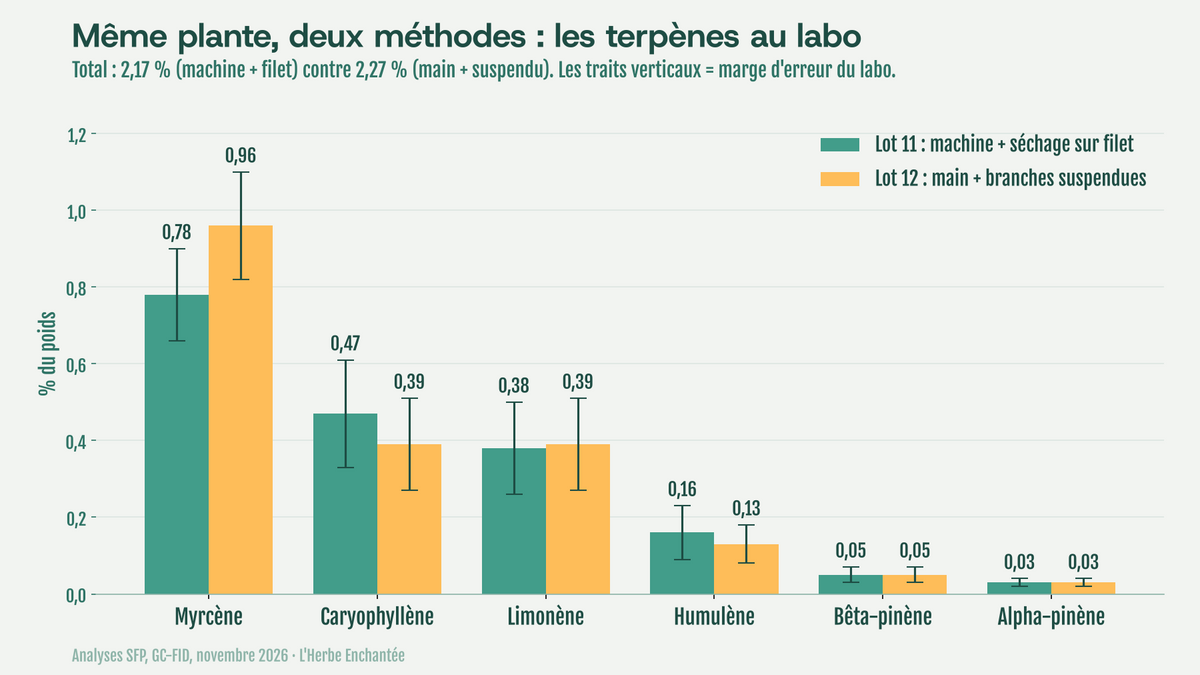
- On my plant, the machine + nets lot shows 2.17% terpenes, the hand + hanging lot 2.27%: a 0.1-point gap.
- That gap is within the laboratory's margin of error.
- Some terpenes are even higher in the machine lot: nothing points to torn-off trichomes.
- What really costs aroma is time in the air and heat, not the method.
What the studies say
I looked before testing: there is no published study comparing these harvesting methods with a terpene analysis. The major scientific review of cannabis post-harvest, published in 2022, admits that these steps are still “more of an art than a science” (Das et al., 2022). Anyone claiming one method is proven, either way, is wrong.
What has been measured is what drives terpenes away. One week of air drying already removes 31% of the flower's aromatic oil (Ross and ElSohly, 1996). And depending on drying temperature, 82% of terpenes remain at room temperature, against 30% at 90 °C (Chen et al., 2021, cited by Das et al.). The enemy is time and heat.
My test: one plant split in two
So that no one could blame a difference in variety or growing conditions, I used a single plant, divided into two halves:
- Lot 11, my method: table defoliator, bucker to remove the buds, trimming with the MasterTrimmer 200 Pro, then drying on nets.
- Lot 12, the “old-school” method: branches cut by hand and hung upside down.
Same drying room, same settings, same drying time and same cure. Both lots went to the same laboratory (SFP) on the same day and were analysed with the same method (gas chromatography, GC-FID).
The lab results

| Terpene (% by weight) | Machine + nets | Hand + hanging |
|---|---|---|
| Total terpenes | 2.17 | 2.27 |
| Myrcene | 0.78 (± 0.12) | 0.96 (± 0.14) |
| Beta-caryophyllene | 0.47 (± 0.14) | 0.39 (± 0.12) |
| Limonene | 0.38 (± 0.12) | 0.39 (± 0.12) |
| Alpha-humulene | 0.16 (± 0.07) | 0.13 (± 0.05) |
| Beta-pinene / alpha-pinene | 0.05 / 0.03 | 0.05 / 0.03 |
A 0.1-point gap on the total, less than 5%. And that gap comes almost entirely from myrcene.
How to read an analysis: the margin of error
Next to each figure, the laboratory gives a measurement uncertainty (the “U.M.” column on the certificate). For myrcene, it is ± 0.12 for the machine lot and ± 0.14 for the hand lot. The true value of the machine lot therefore lies between 0.66 and 0.90%, that of the hand lot between 0.82 and 1.10%. The two ranges overlap: sending the same sample twice could give a gap of that size.
Remember this rule for every analysis you are shown, mine included: two different figures do not make two different results. As long as the ranges overlap, you cannot say one is higher than the other.


Left, the machine + nets lot; right, the hand + hanging lot.
Does the machine tear off the trichomes?
All these terpenes are stored in the same place: the trichomes. If the machine had torn them off, every terpene would have dropped at the same time. Yet caryophyllene and humulene are higher in the machine lot (also within the margin of error), while limonene and the pinenes are identical. The only one that drops slightly is myrcene, the most volatile of cannabis's main terpenes. To me, that looks more like a little evaporation than torn-off trichomes. That is my interpretation, not proof.
Why I stick with the machine and drying on nets
It is not about convenience. By hand, at volume, my harvest would take far longer, and a flower waiting to be trimmed spends time in the air, which is exactly what drives terpenes away. The sooner it reaches the drying room, at 16 °C and 60% humidity, the better. On nets, flowers are sorted by size, barely handled once dry, and go straight to curing. All the details of my drying room are in my drying and curing guide, and the right temperature and humidity combinations in my VPD chart.
One perfectly mastered method is worth another perfectly mastered method: hanging whole branches remains a very good way to dry, as long as you hold the right values.
The limits of this test
It is one plant and one analysis per lot: a trial, not a scientific study. It only covers terpenes, not cannabinoids. And since the harvest method and the drying method change together, it does not tell which of the two matters more. But it is still one more trial than anything published on the subject.
I explain this test on video (in French), with footage from the harvest to the preparation of the lots: my answer to the comments. And to compare both drying methods in detail: hanging or on nets?
To see the result in the bag: the farm's outdoor CBD flowers.
Frequently asked questions
Does machine harvesting damage CBD flowers?
On my plant split in two, the machine-harvested lot had 2.17% terpenes against 2.27% for the hand-harvested lot, a gap within the laboratory's margin of error. No sign of torn-off trichomes.
Is it better to dry cannabis hanging or on nets?
No study settles it. Both methods give a good result if you hold the right values: in the dark, around 16 °C and 60% humidity, for 10 to 14 days.
What makes a flower lose its terpenes?
Time in the air and heat. One week of air drying removes almost a third of the aromatic oil, and high-temperature drying destroys most of it.
How do you read a terpene analysis certificate?
Look at the value and its margin of error (U.M.). If the ranges of two samples overlap, their difference is not significant.
CBD flowers sold in France must contain less than 0.3% THC.
CBD products are not medicines and are reserved for adults.
Quentin, CBD hemp farmer – L'Herbe Enchantée

